Senior financial expertise, without a full-time hire.
Accounting, FBR tax, advisory and audit from Karachi — for companies across Pakistan. Senior financial support for the work you need, when you need it.
Welcome to Fractional Consultants
We are a multidisciplinary firm offering fractional and on-demand financial expertise to organizations across Pakistan and the region. Our partners bring ICAP and ACCA credentials and decades of combined experience in advisory, accounting, taxation and assurance — engaged for exactly as much capacity as your business needs.
Where most providers deliver a service, we take a seat at your table: understanding the business, strengthening governance, and turning financial complexity into a competitive advantage that compounds.
Your Trusted Partner in Every Fraction.
Four integrated pillars, one accountable partner
Engage a single pillar or the full stack. The work stays joined up either way.
Pakistan
Based in Karachi. Working across the country.
We support companies in Karachi, Lahore, Islamabad, Faisalabad and other cities on FBR, SECP, provincial sales tax and IFRS work — without a full-time hire in each location.
How we work
We don't just process data
We partner with you to transform financial complexity into a competitive advantage — through a sequence that is deliberately short on ceremony and long on judgement.
01
Discovery & Analysis
We learn the business, the numbers behind it, and where control or clarity is breaking down.
02
Strategic Planning
We agree priorities, sequencing and the measures that will tell us the work is landing.
03
Collaborative Execution
Our people work alongside yours — embedded in your cadence, not reporting from a distance.
04
Tailored Solutions
What remains is fitted to your business: controls, reporting and capability that hold after we step back.
Why organizations choose us
Integrated Expertise
Advisory, accounting, tax and assurance under one accountable roof — no hand-off gaps.
Personalized Partnership
Senior people on your engagement, shaping solutions around your objectives.
Proven Reliability
Deadlines met, standards held, confidentiality assumed — every engagement.
Diverse Experience
Multi-industry and multi-regulator exposure, from manufacturing to non-profits.
Measurable Value
Outcomes stated in the language of the business: margin, cash, risk, compliance.
Industries
Sector context, not generic advice
Manufacturing & Industrial
Costing discipline, inventory controls and capex governance.
Trading, Distribution & Logistics
Working capital, margin leakage and multi-location reconciliation.
Non-Profits
Donor compliance, grant reporting and fund accounting.
Technology & Start-ups
Investor-ready reporting, runway visibility and first-time controls.
Services & Consulting
Utilisation, revenue recognition and partner-level reporting.
Construction & Real Estate
Project accounting, milestone billing and contract governance.
The people you'll work with
AK
Asad Khalil
Managing Director
CA (ICAP) and ACCA with 15+ years across external and internal audit, advisory, tax and accountancy.
AW
Abdul Wasay
Director, Assurance
ACCA with 15+ years in external audit, advisory and full-spectrum accounting.
MS
Maryam Siddiqui
Director, Advisory
ACCA with 10+ years in internal audit, financial controls and accountancy.
Insights
Not sure where to start with your business finances?
Tell us what’s holding your business back. A partner will help you identify the right support—accounting, tax, advisory, or assurance.
About the firm
A partner sized to your business, not to a billing model
Fractional Consultants brings ICAP- and ACCA-qualified partners to organizations that need senior financial judgement in measured amounts — permanently available, never permanently on payroll.
Vision
To be the trusted strategic partner our clients turn to first — driving sustainable value and long-term growth through clarity, insight and integrity.
Mission
To deliver integrated advisory, accounting, taxation and assurance services that strengthen transparency, governance and compliance — and make sustainable growth possible.
Our values
Integrity
We hold to the highest ethical standards in every engagement, and say what we find even when it is inconvenient.
Excellence
We pursue quality in the detail — professional standards applied consistently, not selectively.
Client Partnership
We work as an extension of your team, aligning our effort with your objectives rather than a fixed scope.
Innovation
We adopt better tools, systems and methods so financial functions get simpler as they scale.
Confidentiality
Your information is protected with the discipline expected of a professional practice, without exception.
Accountability
We own our commitments and our conclusions — outcomes, deadlines and quality alike.
Why organizations choose us
Integrated Expertise
Advisory, accounting, tax and assurance under one accountable roof — no hand-off gaps.
Personalized Partnership
Senior people on your engagement, shaping solutions around your objectives.
Proven Reliability
Deadlines met, standards held, confidentiality assumed — every engagement.
Diverse Experience
Multi-industry and multi-regulator exposure, from manufacturing to non-profits.
Measurable Value
Outcomes stated in the language of the business: margin, cash, risk, compliance.
Tell us what you're solving for. We'll tell you what it takes.
Services
Four pillars. Engage one, or all of them.
Each pillar stands alone as a complete service and strengthens the others when combined. Scope moves with your business — up for a transaction or a filing season, down when steady state returns.
Pillar 01
Financial Advisory
When capital, control or continuity is at stake, the analysis has to be right and the counsel has to be candid. We support boards and owners through transactions, pressure on cash, and the redesign of how finance actually operates.
Deal & valuation
Business and asset valuations
Financial due diligence
Deal structuring support
Feasibility and business plans
Cash & turnaround
Working-capital optimisation
13-week cash forecasting
Restructuring and turnaround plans
Lender and creditor negotiation support
Risk, ESG & fraud
Enterprise risk frameworks
ESG readiness and reporting
Fraud risk assessment
Whistleblowing and ethics processes
Operating model, SOPs & KPIs
Finance function design
Policies, SOPs and delegation matrices
KPI and management-reporting design
Cost and profitability analysis
Systems, ERP & audit quality
ERP selection and implementation support
Process automation and controls in systems
Internal audit quality assessment
Audit readiness reviews
Technical training
IFRS application workshops
GIAS-aligned internal audit training
COSO internal control framework
Tailored finance-team upskilling
Financial Advisory Services – Key Benefits
Informed Decision-Making
Improved Profitability
Stronger Financial Resilience
Strategic Clarity
Enhanced Investor Confidence
Robust Financial Governance and Compliance
Have a decision, a deal or a cash problem in front of you?
Pillar 02
Accounting & Bookkeeping
Books that close on time and numbers management can act on. We run the finance function end to end — or fill precisely the layer you're missing, up to and including a fractional CFO.
Transaction processing
Bookkeeping in QuickBooks, Xero, Zoho, SAP, Oracle NetSuite and Odoo
Chart-of-accounts design and clean-up
Migration and historical catch-up
Reporting & close
Month-end and year-end close
Management accounts and dashboards
Statutory financial statements
Close calendars and checklists
AP/AR, payroll & assets
Payables and receivables cycles
Payroll processing and statutory deductions
Fixed-asset registers and depreciation
Bank, inventory and intercompany reconciliations
FP&A
Budgets and rolling forecasts
Variance analysis and commentary
Cash-flow planning
Scenario and sensitivity modelling
Fractional CFO
Board and investor reporting
Banking and lender relationships
Finance-team leadership and hiring
Capital planning support
Standards & audit support
IFRS and US GAAP application
Consolidations and group reporting
Fund and NPO accounting
Audit schedules and auditor liaison
QuickBooks Online
Xero
Zoho Books
Sage Intacct
Oracle NetSuite
FreshBooks
Wave
Odoo
Dynamics 365
SAP Business One
Acumatica
TallyPrime
MYOB
FreeAgent
Oracle Fusion ERP
Accounting and Bookkeeping Services – Key Benefits
Accurate and Timely Financial Records
Operational Efficiency
Better Cash Flow Control
Regulatory Compliance
Scalable Financial Systems
Strategic Financial Oversight
Want a close you can trust and reporting you can present?
Pillar 03
Taxation & Regulatory Compliance
Compliance handled as a calendar, not a crisis. We manage Pakistan's federal and provincial tax obligations and the surrounding regulatory filings, and we plan positions in advance rather than defending them afterwards.
Corporate, personal & expatriate tax
Corporate income tax returns and advance tax
Personal and partnership returns, wealth statements
Expatriate tax planning and residency positions
Notices, audits and appeals representation
Withholding & sales tax
Withholding statements and agent compliance
Federal sales tax and provincial services tax (SRB, PRA)
Input tax reviews, refunds and exemptions
Reconciliation of tax ledgers to financials
Registrations
NTN and sales-tax registration
Company incorporation and branch registration
Provincial revenue authority enrolments
Changes in structure, directors and capital
Regulatory & statutory filings
SECP annual and event-based filings
EOBI, social security and labour funds (WPPF, WWF)
Intellectual property registration support
PSEB, chamber of commerce and customs matters
Taxation & Regulatory Compliances – Key Benefits
Optimized Tax Position
Zero Penalties and Legal Risks
Comprehensive Regulatory Coverage
Confidence in Cross-Border Transactions
Simplified Compliance Administration
Peace of Mind
Bring your filing calendar under control before the next deadline.
Pillar 04
Audit & Assurance
Independent work that gives boards a defensible view of how the organization is actually running — scoped by function and risk, reported in language management can act on.
Internal audit by function
Procurement, inventory and production
Sales, receivables and treasury
HR, payroll and administration
Risk-based annual audit plans
Corporate governance
Code of Corporate Governance compliance
Board and committee process reviews
Related-party and conflict controls
Policy and charter development
IT, cyber & ERP audits
General IT controls review
Access rights and segregation of duties
ERP configuration and interface controls
Cyber-hygiene assessments
Forensic & agreed-upon procedures
Fraud investigations and asset tracing
Whistleblower complaint reviews
Agreed-upon procedures engagements
Management-requested special reviews
Grant & joint-venture audits
Donor and grant expenditure verification
Programme compliance reviews
Joint-venture and partner audits
Cost-sharing and allocation testing
ICFR, BCP & DR
ICFR documentation and testing
Control gap remediation plans
Business continuity planning
Disaster-recovery readiness reviews
Audit and Assurance – Key Benefits
Improved Internal Controls
Enhanced Transparency and Accountability
Fraud Prevention and Detection
Stronger IT and Cyber Resilience
Regulatory and Governance Confidence
Continuous Improvement Culture
Need an independent read on controls before your board asks for one?
Industries
Expertise shaped around your sector.
Explore the financial priorities in your industry and the services that can help.
Manufacturing & Industrial
Margins are decided at the level of costing accuracy, inventory control and plant spending discipline. We see standard costs that drifted years ago, stock counts that don't reconcile, and capex approved without a business case — each quietly distorting reported profitability.
Cash is tied up in stock and receivables while credit terms creep outward. Multi-location operations make reconciliation slow and margin leakage hard to see. We tighten working-capital cycles, fix reconciliation discipline, and get withholding and sales-tax treatment right across jurisdictions.
Donor confidence rests on demonstrable compliance: restricted-fund accounting, grant-specific reporting and audit trails that survive scrutiny. We build fund structures that report cleanly by project and donor, and conduct the expenditure verification funders increasingly require.
Finance is usually the last function to be built, and it is the one investors examine first. We stand up investor-grade reporting, runway and burn visibility, revenue recognition that holds up, and the first real set of controls — sized so it doesn't slow the company down.
Profitability lives in utilisation and engagement economics, yet reporting often stops at firm-level revenue. We build client- and engagement-level margin reporting, align revenue recognition with delivery, and get provincial services-tax positions correct.
Long project cycles hide cost overruns until they are irreversible. We implement project accounting with milestone billing, retention and variation tracking, contract-compliance review, and cash forecasting built around the project schedule rather than the calendar month.
Tell us your sector and we’ll tell you where we’d look first.
Approach
We don't just process data
We partner with you to transform financial complexity into a competitive advantage. Four stages, run in sequence, with the same partners from first conversation to handover.
01
Discovery & Analysis
We start by understanding the business, not just the ledger — how revenue is earned, where cash is consumed, who approves what, and which numbers management already distrusts.
What you get
A written baseline: findings, risks, quick wins, and a candid view of what is and isn't worth fixing now.
02
Strategic Planning
Priorities are agreed with you and sequenced against capacity, deadlines and regulatory dates — so the plan reflects what your team can absorb, not an ideal-world roadmap.
What you get
A scoped plan with owners, timelines and the measures that will show whether it worked.
03
Collaborative Execution
Our people work inside your cadence — your close calendar, your board meetings, your systems. Progress is visible weekly, and surprises are raised early rather than at the end.
What you get
Delivered work in your systems, with your team trained on it as it lands.
04
Tailored Solutions
What remains is fitted to your organization: documented processes, working controls and reporting your team can run without us — with our partners available for the fraction you still need.
What you get
Durable capability, documented — plus measurable value stated in margin, cash, risk or compliance terms.
Team
The partners you meet are the partners who do the work
A small, qualified leadership team — ICAP and ACCA credentialed, with experience across audit, advisory, tax and accountancy.
AK
Asad Khalil
Managing Director
CA (ICAP) · ACCA
Over 15 years of experience spanning external and internal audit, financial advisory, taxation and accountancy. Leads the firm's advisory practice and partner-level oversight across engagements.
AW
Abdul Wasay
Director, Assurance
ACCA
Over 15 years in external audit, financial advisory and full-spectrum accounting. Responsible for assurance engagements and audit quality across the firm's client base.
MS
Maryam Siddiqui
Director, Advisory
ACCA
Over 10 years in internal audit, financial controls and accountancy. Leads control design and internal audit programmes for clients across sectors.
Our partners' experience spans leading organizations across manufacturing, trading, technology, non-profit and services sectors, supported by a network of qualified professionals engaged as each mandate requires.
Speak directly with a partner — no account managers in between.
Contact
Request a consultation
Tell us what you need help with. A partner will review your enquiry and contact you to discuss the next step.
Service packages
Engage by the fraction, not by the headcount
Four ways to work with us. Same partners, same standards — the shape of the engagement changes with the problem. Pricing is set after a scoping conversation, not published as a menu.
PACKAGE 01
Retained fraction
A standing allocation of senior days each month — fractional CFO, finance oversight, or a recurring internal-audit programme. Best when the work is continuous and you do not need a full-time seat.
Fixed monthly capacity, reserved in the diary
Board packs, lender packs, and standing reviews
Same partner across the year
PACKAGE 02
Project engagement
A defined outcome and a defined end. Valuations, due diligence, close clean-ups, ICFR programmes, ERP readiness, or a one-off forensic review.
Written scope, timeline and deliverables
Partner-led, staffed to the work
Handover documented in your systems
PACKAGE 03
Compliance calendar
Tax and statutory filings run as a year-round calendar: corporate and personal returns, withholding, sales tax, SECP, labour funds. We tell you what we need, and when.
Deadline map for FBR, SECP and provincial authorities
Advance requests, not last-week scrambles
Notices and audits handled as they arise
PACKAGE 04
Advisory on call
Access to a partner between retained months or projects — for a transaction question, a notice from the tax office, or a board paper that needs a second pair of eyes.
Priced by the fraction of time used
Same people who already know the file
Can convert into a project when the work grows
How we choose a package
We do not sell a bundle you do not need. The first conversation maps the constraint — cash, close, compliance, or credibility — then we recommend one package, or a short sequence of two.
Values and culture
How the work is actually run
These are not a slide. They decide who we take on, how we staff a file, and what we will not sign.
Integrity
We report what the numbers say, including when that is inconvenient for a deal, a filing position, or a management narrative. If we cannot stand behind a conclusion, we will not issue it.
Excellence
Professional standards applied consistently — ICAP, ACCA, IFRS, and the relevant local statute. Quality is checked before it leaves, not after a client finds the error.
Client partnership
We sit inside your cadence: your close, your board, your systems. The partners you meet are the people on the work. We do not rotate a junior bench through your file.
Innovation
We use the stack you already own — QuickBooks through SAP — and only recommend a change when the current system is the constraint. Technology is a tool, not a product we are selling.
Confidentiality
Client information is treated as a professional secret. We do not use your name, your numbers, or your situation as marketing unless you ask us to.
Accountability
Deadlines, conclusions and quality are owned. If we miss, we say so and we fix it. Outcomes are stated in margin, cash, risk or compliance — not in activity hours.
If this is how you want a finance partner to behave, we should speak.
Insights
Practical guides for finance teams and business owners, including 2026–2027 tax planning, digital invoicing, audit preparation and sustainability reporting.
Guide · Tax · Pakistan
Withholding as a system, not a monthly panic
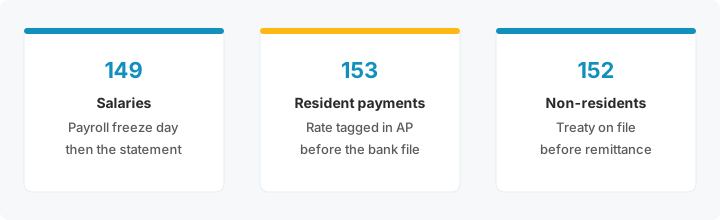
Late statements under 149, 153 and 152 are usually a close problem, not a law problem. The deduction sits in AP. The evidence sits with procurement. The statement is built on the last Friday of the month.
Map three codes to the ledger
149 — salaries. Lives with payroll. If payroll is late, the statement is late. Freeze the payroll file on a named day, then file.
153 — payments to residents. Lives with AP. Every vendor needs a rate and a nature-of-payment tag before the invoice is posted, not after the bank file is made.
152 — payments to non-residents. Lives with treasury and the contract. Treaties and exemptions have to be on the file before the remittance, or you withhold the default rate.
Who this is for
A company that already withholds, but the monthly statement is a project. Finance, payroll and AP do not share one freeze date. Notices arrive because a vendor was tagged after payment, or a remittance went out without the treaty paper.
What “done” looks like
One freeze day for payroll, AP and treasury.
Vendor master with rate and nature of payment, maintained, not rebuilt.
Monthly pack: statement, tax ledger, bank proof, one-page exceptions.
152 file: contract, residency, exemption — before the SWIFT, not after.
Common mistakes
Filing from the bank book instead of the tax ledger. Treating 153 as “whatever last year’s clerk used.” Leaving 152 to the bank’s operations desk. If those four pack items do not exist, you do not have a withholding process. You have a scramble.
Guide · Tax · Pakistan
Provincial sales tax on services — who is actually in scope
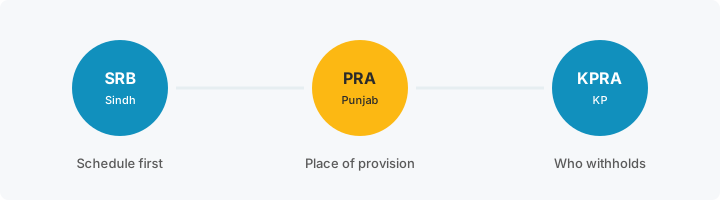
SRB, PRA and KPRA are not a second sales-tax department. They tax specified services, in specified places, at specified rates. Most errors are “we copied last year’s return” or “we registered everywhere to be safe.”
Three questions before you file
Is the activity a taxable service in that province’s schedule?
Where is the service treated as provided?
Who is the recipient — and do they withhold?
Answer those on a one-page matrix per revenue line. Then register only where the matrix says you must.
Consulting, IT and inter-company charges
These are where notices usually start. A Karachi firm billing a Lahore group, or a shared-services charge with no contract, will be read two ways. Write the position before the invoice, not after the notice.
What we put on the matrix
Revenue line, description of the service, customer province, place-of-provision rule you are using, rate, withholding or not, and the contract clause. If a line cannot fill those cells, do not invoice it yet.
Guide · Compliance · Pakistan
SECP filings directors forget until the penalty letter
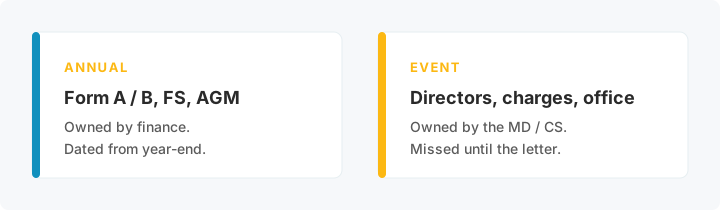
Annual returns are on the calendar. Event filings are not. A director change, a charge on assets, a shift in registered office, or an allotment that nobody told finance — that is what produces the letter.
Split the diary
Annual. Form A / B, financial statements, AGM timeline. Owned by finance, dated from year-end.
Event. Owned by the company secretary or the MD’s office. Finance only sees it if someone forwards an email. Build a one-page “what happened this month” that legal and the board must sign before the close.
Events that usually go unfiled
Director or CEO change after a family meeting, not a board paper.
Bank charge created for a facility, never reported.
Allotment or transfer that only exists in a WhatsApp thread.
What we check in the first week
Latest Form A against the actual directors and share register. Open charges. Registered office versus the letterhead. If those three do not match, stop talking about tax and fix the company file.
Guide · Assurance · Pakistan
Internal audit for a family manufacturing group
In a family plant, the losses that matter are usually not in the general ledger. They are in procurement, inventory, and related-party dealings that everyone in the building already knows about and nobody has written down.
Start where cash leaves
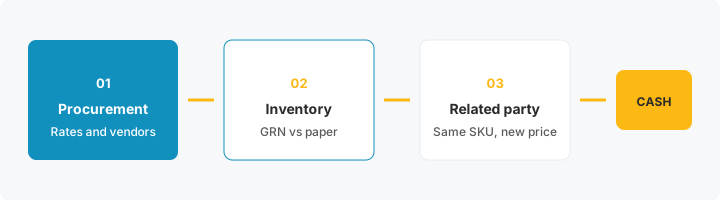
Vendor selection, rate cards, goods-receipt versus invoice, and stock that exists on paper. Related-party sales and purchases next — same SKU, different price, no contract. HR and cash payments after that, not first.
The four walks
Procurement: who can add a vendor, who can change a rate, who signs the PO.
Inventory: GRN versus invoice, count versus ledger, scrap versus theft.
Related party: same SKU, different price, no written terms.
Cash: petty cash, job-work, and “adjustments” that never hit a named account.
How not to do it
A 40-page report on “tone at the top” with no SKU, no GRN, and no named owner. The next generation will not act on that. Give them exceptions, amounts, and a 90-day fix list they can put in a Monday meeting.
What the pack contains
Exception list with rupee amounts, the control that failed, the owner, and the date it should be closed. Not a maturity model. Not a lecture on COSO. If it cannot be discussed in forty minutes, it is too long.
Guide · Accounting · Pakistan
Donor and NPO reporting that survives a funder audit
A funder does not want your entity P&L. They want their grant, their restrictions, and a trail from bank to activity. Section 2(36) approval and 100C relief sit on top of that — they do not replace it.
Build the books by fund
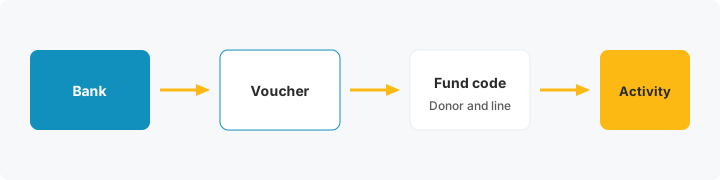
One chart, many funds. Restricted, unrestricted, and endowment coded at the posting, not in a spreadsheet after the year. If a voucher cannot name the donor and the budget line, it should not be posted.
The trail a funder will walk
Bank credit matches the grant agreement amount and date.
Voucher names the fund, the budget line, and the activity.
Unused balance reconciles to cash held for that donor.
Timesheets or outputs exist for the period they paid for.
What the audit folder must hold
Grant agreement, approved budget, bank trail, timesheets or activity evidence, and a reconciliation of unused funds. 100C and 2(36) papers in a separate sleeve. If you cannot produce that in a week, the next funder visit will write the findings for you.
Guide · Accounting · Pakistan
IFRS 15 and 16 in a first-time close
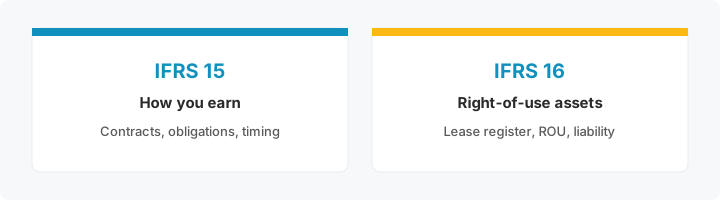
First-time application is not a memo. It is a list of contracts. IFRS 15 for how you earn; IFRS 16 for what you have the right to use. Most first closes fail because someone started with the standard and not with the files.
IFRS 15 — contractors and SaaS
Identify the performance obligations, then decide over-time versus point-in-time. Retention, variations and mobilisation fees are where local contractors usually sit on the wrong side of the year. Software and retainers: if the customer can use the service as you deliver it, you do not dump the invoice into month one.
IFRS 16 — leases you already have
Offices, warehouses, plant on hire-purchase that was treated as rent. Build a lease register: term, payments, renewal, discount rate. Then the ROU asset and liability. Short-term and low-value exemptions are a decision, not a habit.
Files before the standard
Every material customer contract, not a sample of “typical” ones.
Every lease and hire that looks like rent on the P&L.
Opening balances you can defend, not a plug to make the trial balance close.
A one-page policy note the auditor can attach, written after the files, not before.
Guide · Tax · Pakistan
When Super Tax and minimum tax change the deal
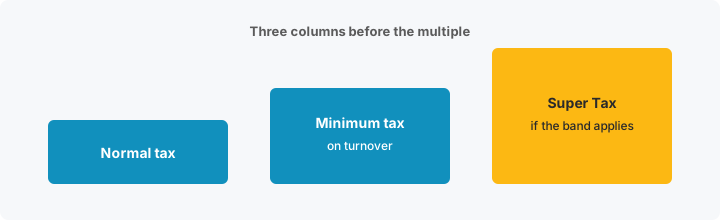
A valuation or a cash forecast that uses “corporate rate only” is not a model. In Pakistan, Super Tax on higher income and minimum tax on turnover can move the price and the earn-out more than the headline rate.
Build the tax line before the multiple
Run three columns: normal tax, minimum tax, Super Tax if the income band applies. Then look at cash — not just PAT. A buyer who prices on EBITDA and discovers minimum tax at close will reopen the number.
Where the model usually lies
Turnover is up, profit is thin — minimum tax is the cash tax.
Income crosses a Super Tax band in the earn-out years.
Credits sit unused because nobody modelled the limitation.
The data room has returns, not a bridge from PAT to tax paid.
What we put in a deal pack
Three-year tax paid versus accounting profit, unused credits, and a one-page note on which Finance Act rates the model used. If those are not in the data room, we write them before anyone talks multiple.
Service · Accounting
Fractional CFO
Senior finance leadership without a full-time hire. A partner who sits with the board, the bank and the close — a few days a month, or through a defined transaction.
Board and lenders
Packs that survive a board or credit-committee reading. Cash, covenants, and a narrative that matches the numbers.
The close and the forecast
A close calendar, a rolling forecast, and a person who will not let the two drift apart.
The team under you
Hiring, coaching and process for the accountant or controller who runs the books between our days on site.
Typically retained
Two to six senior days a month, reserved. Combined with bookkeeping or tax when those layers are also missing. See the retained-fraction package.
Typically a project
A raise, a refinance, a sale, or a 90-day clean-up of reporting. Then we either step down or convert to a retain.
Not sure if you need a CFO or a better close? That is the first conversation.
Service · Advisory
Business valuation
A number you can take to a buyer, a lender, a court, or a partner — with the workings attached. We value businesses and assets; we do not sell a single “rule of thumb” multiple.
When it is commissioned
Sale, purchase or internal transfer of shares
Shareholder or family disputes
Bank and investor due diligence support
Feasibility and capital-raise models
How we work
Income, market and asset approaches as the facts allow
Normalisations you can defend
Written report with assumptions in the open
Can sit alongside financial due diligence
Need a valuation that will be read by someone who disagrees with you?
Service · Accounting
Payroll
Payslips that match the statute and the bank. We process payroll, deductions and the related filings — EOBI, social security, withholding — so HR is not inventing a finance function.
Monthly processing
Gross-to-net, allowances, overtime and final settlements, in the ERP or payroll tool you already run.
Statutory filings
Withholding on salaries, EOBI, SESSI or PESSI, and the labour-fund calculations that sit beside payroll.
Controls
Joiner and leaver checklists, bank-file review, and a reconciliation to the general ledger every cycle.
Want payroll out of the founder’s spreadsheet?
FAQ
Questions we hear in the first conversation
Are you a replacement for a Big Four firm?
No. We are a fractional practice. If you need a statutory external audit opinion from a large network firm, we will work alongside them — we do not pretend to be them.
Do you work with companies outside Karachi?
Yes. We are based in Karachi and work with companies in Lahore, Islamabad, Faisalabad, Peshawar, Multan, Sialkot and other cities. Most mandates are remote, with site time when the file needs it. See the city pages in the footer.
Do you have an office in the UAE?
We are based in Karachi. UAE work is delivered through professional firms in the region, so licensed people sign licensed work.
Who does the work?
The partners named on this site, supported by qualified staff as the mandate requires. You will not be handed to an account manager.
How are you paid?
By package: a monthly retain, a fixed project fee, a compliance calendar, or advisory time. We agree the shape before we start. See Service packages.
Can you take over our books this month?
Often yes for bookkeeping and payroll, once we have access and a chart we trust. Advisory and assurance start with a short discovery so we do not audit the wrong thing.
Will you use our name as a case study?
Not unless you ask us to. Confidentiality is a value, not a slogan.
Legal
Privacy
Fractional Consultants is based in Karachi. This site collects only what you send us: the enquiry form (name, organisation, email, phone, message) and standard server logs.
Enquiries are used to respond to you. We do not sell contact details. Professional files are held under the confidentiality standards of the engagement.
This is a short notice for the public site, not a substitute for the terms of a signed engagement.
Tax · 2026–2027
Tax Year 2026 and 2027: a practical finance-team checklist
Published 6 September 2026 · General guidance
Separate the return you are preparing from the year you are forecasting, and keep tax assumptions traceable.
Start with the correct period
For a normal June year-end, Tax Year 2026 covers 1 July 2025 to 30 June 2026. Tax Year 2027 covers 1 July 2026 to 30 June 2027. Businesses using an approved special tax year need a separate period check. These are income periods, not interchangeable labels for filing deadlines.
Use enacted material for the tax model
FBR lists Finance Act 2026 and an Income Tax Ordinance updated through 30 June 2026. Use the enacted provisions and their effective dates when reviewing the business, rather than carrying forward a budget proposal or last year’s spreadsheet. This guide does not set out tax rates or confirm how individual amendments apply.
Prepare two connected workbooks
For the completed year, reconcile the trial balance, return workings, advance payments and withholding certificates. Record outstanding differences with an owner. For the current year, maintain a forecast of taxable income and tax cash payments, separating documented assumptions from issues awaiting advice. Review payroll, supplier payments and transactions with non-residents by their nature and applicable treatment.
Make the review repeatable
Keep a change register with the legal reference, effective date, affected transaction, system setting and reviewer. Agree an internal review date before each applicable filing or payment deadline. Check the entity’s actual obligations and any official extensions; a generic calendar cannot establish the deadline for every taxpayer.
Planning for later in 2027
Revisit the forecast when enacted changes affect it. Do not present an anticipated Finance Act 2027 or a possible rate change as established law. A useful planning model can show alternative assumptions without treating them as legal requirements.
Sources and applicability
Sources checked on 6 September 2026. Requirements depend on the entity and reporting period; check subsequent amendments before acting.
Discuss your reporting or compliance priorities with a partner.
Tax & systems · 2026
FBR digital invoicing in 2026: controls beyond the connection
Published 6 September 2026 · General guidance
Check invoice acceptance, exception handling and reconciliations before treating an integration as complete.
Confirm which rules cover the business
FBR’s digital-invoicing guidance addresses integration for corporate and non-corporate registered persons under the sales-tax framework. Confirm the applicable notification, taxpayer category and any subsequent extension before assigning a compliance date. A federal sales-tax integration is not evidence that every provincial or income-tax obligation has been met.
Trace an invoice end to end
As a practical control check, select a normal sale and follow it from the order through the invoice, integration response, accounting entry and return reconciliation. Retain the acceptance reference and the underlying transaction record. A successful connection test does not prove that all production invoices have been accepted.
Build an exception queue
Assign an owner to rejected, duplicate and delayed submissions. Record why each failed, the correction made and the final outcome. Test credit notes, cancellations and retries using the applicable technical specifications. Keep changes traceable so a correction does not silently create a second sale or leave a gap in reporting.
Reconcile before the month closes
Compare the sales ledger with accepted invoice records and the return workings. Investigate timing differences, tax classifications, reversals and missing transactions. Restrict access to credentials and tax settings, and review changes to the customer and product master data. These are recommended operating controls, not a substitute for the prescribed invoicing rules.
What management should receive
A short monthly report should show unresolved exceptions, reconciliation differences and actions awaiting approval. Keep the supporting evidence accessible to the finance team and the auditor. Before changing production behaviour, confirm the current FBR technical guidance with the implementation team.
Sources and applicability
Sources checked on 6 September 2026. Requirements depend on the entity and reporting period; check subsequent amendments before acting.
Discuss your reporting or compliance priorities with a partner.
Audit readiness · 2026–2027
Preparing for a 2026–2027 audit: an evidence checklist for Pakistani businesses
Published 6 September 2026 · General guidance
Prepare reconciliations, estimates and system records that help auditors investigate the risks that matter.
Agree the scope before gathering files
Start by confirming whether the assignment is a statutory financial-statement audit, an internal audit or another assurance engagement. Agree responsibilities and an evidence request list with the appointed auditor. This checklist supports preparation; it does not establish whether a particular business is legally required to obtain an audit.
Explain what changed this year
Prepare a concise account of new borrowing, major customers, related-party arrangements, system migrations and significant estimates. Risk assessment is central to ISA 315. Giving the auditor a clear record of business and system changes helps focus discussions on areas where the financial statements could be misstated.
Make balances traceable
Reconcile cash, receivables, payables, inventory and fixed assets to the trial balance. Keep support for unusual journals and post-close adjustments. Explain old reconciling items rather than rolling them forward without an owner. For inventory, discuss count arrangements and cut-off evidence with the auditor early.
Support judgement with evidence
Keep the assumptions behind impairment, provisions and forecasts alongside the data used to develop them. For a manufacturing or trading business, this may include slow-moving stock, disputed receivables, financing terms and purchase commitments. Document management’s assessment instead of leaving the auditor to reconstruct it from email.
Include the systems trail
Identify who can create vendors, change bank details, post journals and override approval limits. Retain access reviews, change approvals and relevant integration logs. Track unresolved requests in one list with an owner and due date. Preparing records improves the process; it does not guarantee an unmodified audit opinion or replace the auditor’s independent work.
Sources and applicability
Sources checked on 6 September 2026. Requirements depend on the entity and reporting period; check subsequent amendments before acting.
Discuss your reporting or compliance priorities with a partner.
Reporting & assurance · 2026–2027
Sustainability reporting in Pakistan: preparing for the 2026 and 2027 phases
Published 6 September 2026 · General guidance
Identify the applicable reporting phase and prepare evidence before sustainability assurance begins.
Check the company’s reporting phase
ICAP’s implementation guidance describes phased adoption of IFRS S1 and IFRS S2, with the second and third phases starting in July 2026 and July 2027. Scope depends on company classification and the applicable size criteria; it is not a requirement for every Pakistani SME. Confirm the company’s position against the operative SECP notification and any amendments.
Separate a period start from a deadline
The start of an applicable reporting period is not the date the report must be filed. Work out the company’s first covered period, the reporting timetable and any available transition relief separately. ICAP’s guidance states that assurance by the company’s auditor begins from the second reporting year. Confirm the requirements for the specific reporting cohort.
Give the information clear owners
IFRS S1 addresses sustainability-related risks and opportunities that could affect cash flows, access to finance or the cost of capital. Its disclosure areas include governance, strategy, risk management, and metrics and targets. Assign responsibility across finance, operations and management so the report is supported by records rather than assembled only at year-end.
Prepare an evidence register
For each material metric, record its definition, source, calculation, owner and review. Retain supporting records such as utility bills and operating data where relevant. Explain reporting boundaries, estimates and corrections. Link material financial assumptions to the information used elsewhere in the business, and resolve inconsistent figures before publication.
Start with a scoped readiness review
Establish the applicable phase, compare existing information with the disclosure requirements and prioritise evidence gaps. Discuss assurance scope and independence with the appointed auditor early. This is a preparation guide; detailed applicability, reliefs and assurance requirements need to be confirmed for the company.
Sources and applicability
Sources checked on 6 September 2026. Requirements depend on the entity and reporting period; check subsequent amendments before acting.
Discuss your reporting or compliance priorities with a partner.
Locations · Sindh
Accounting, tax and audit in Karachi
Karachi is where we are based. The work here is usually a mix of month-end close, SRB on services, FBR withholding, and group reporting for companies that also have plants or branches in Punjab.
Partners sit in Karachi. You get named people on the file, not a remote call-centre bench.
A services invoice billed from Karachi can sit in SRB while the same month’s payroll and supplier payments sit in FBR. We keep those calendars on one checklist so a notice in one authority does not surprise the other.
Port, trading and shared-service groups
Trading houses, logistics and groups with a Karachi head office often run intercompany charges to a Lahore or Faisalabad plant. We write the position before the invoice, and keep the trail the auditor will ask for.
Books that close on time
Bank, inventory and intercompany reconciliations, then management accounts a board can read. QuickBooks, Xero, NetSuite, SAP and Odoo are already in use across the city — we work in yours.
Internal audit without a standing team
Procurement, treasury and related parties in family groups headquartered here. Scoped by risk, reported in language management can act on.
Services for Karachi businesses
Engage one pillar or the stack. The same partners stay on the work.
Other cities
Talk to a Karachi partner about the close, a notice, or a decision in front of you.
Lahore files are often family manufacturing groups, services businesses on PRA, and companies that keep a legal office here while cash and inventory sit on a plant elsewhere in Punjab.
We do not claim a Lahore branch office. Partners are based in Karachi and work with Lahore companies remotely, with site time when the file needs it.
Punjab sales tax on services is a separate calendar from federal withholding and income tax. We map which invoices are in PRA, which are federal, and who owns each return before the month closes.
Family groups and related parties
Director current accounts, shared premises, and management fees between a Lahore company and a plant in Faisalabad or Multan. Internal audit starts where cash can leave, not with a generic checklist.
SECP events directors forget
Director changes, charges and allotments filed late generate penalties that have nothing to do with the tax return. We keep event filings on the same board as the annual return.
Board packs that survive a bank meeting
Cash, covenants and related-party balances in language a Lahore board or lender can use. Fractional CFO time, not a slide deck from a junior bench.
Services for Lahore businesses
Other cities
Need PRA, SECP or group reporting handled for a Lahore company?
Islamabad work is often a head office, a donor-funded entity, or a contractor to the federal government. Rawalpindi companies next door sit in Punjab, so PRA can apply even when the finance team sits in the capital.
We do not have an Islamabad office. Karachi partners deliver remotely and travel when the engagement needs it — including Rawalpindi plants and shared-service teams.
What Islamabad and Rawalpindi companies usually need
ICT services tax is not PRA
Islamabad Capital Territory has its own sales tax on services. A Rawalpindi invoice can be PRA. We confirm the place of business and the nature of the service before anyone registers in the wrong authority.
Donor and NPO reporting
Restricted funds, bank-to-activity trails, and the papers a section 2(36) or 100C review will ask for. Fund accounting that survives a donor audit, not a spreadsheet rebuilt at year-end.
Federal contractors and project books
Advance tax, withholding on payments, and project-wise reporting when one legal entity runs several contracts. The close has to explain both the ledger and the contract file.
Two-city groups
Islamabad registered office, Karachi operations, Lahore sales. We keep one chart and one close calendar so each location does not invent its own numbers.
Services for Islamabad businesses
Other cities
Discuss ICT, donor or federal filing work with a partner.
Faisalabad files are usually spinning, weaving, processing or a trading arm that exists to serve the plant. The numbers that matter are costing, inventory, energy, and whether export or local sales are being taxed as the contracts actually read.
No Faisalabad branch office. Karachi partners work the file remotely and come to the mill when inventory, related parties or a lender pack needs it.
Yarn, greige and finished goods that do not reconcile to the trial balance are how margins disappear. We tie the register to the close before anyone presents a contribution figure to the board.
PRA, FBR and export documentation
Local services sit in PRA. Payroll and supplier withholding sit in FBR. Export documentation has to match the sales ledger. One calendar, not three unofficial ones.
Working capital under seasonality
Cotton cycles, energy deposits and customer advances. Thirteen-week cash and a close that explains why stock went up when sales did not.
Group structures with a Karachi or Lahore office
A plant here and a company there. Intercompany, management fees and related-party balances are where family groups lose arguments with auditors and bankers.
Services for Faisalabad businesses
Other cities
Get the Faisalabad close, costing and tax calendar under one partner.
Peshawar companies sit under KPRA for many services, FBR for withholding and income tax, and SECP if they are incorporated. Finance teams are often small, so the risk is a missed provincial registration or a file that cannot explain a contract.
We are based in Karachi. Peshawar mandates are delivered remotely, with site time for inventory, contractors or a board that wants the partners in the room.
Not every Peshawar business belongs on a KPRA registration, and some that do have never filed. We check the nature of the service and the place of business before adding another login to the close.
Contractors and project books
Advances, retention and withholding on payments. The ledger has to follow the contract, or the next notice will reconstruct it for you.
FBR and SECP on a short bench
Monthly withholding, annual returns and event filings when there is no in-house tax person. We run the calendar; you keep the decisions.
Groups that also trade in Punjab or Sindh
A Peshawar company billing Lahore or Karachi can create two provincial readings of the same invoice. Write the position before the invoice goes out.
Services for Peshawar businesses
Other cities
Bring KPRA, FBR and the Peshawar close onto one calendar.
Multan work is often agri, ginning, trading or a family company with seasonal cash. PRA covers many services. The books have to explain inventory that moves with the harvest, not only a month-end that looks tidy.
No Multan office. Karachi partners handle the file remotely and visit when stock, related parties or a bank pack needs people on the ground.
Advances to growers, stock that sits, and a working-capital story a bank will not accept as “the season”. We forecast cash in weeks, not only in annual budgets.
PRA and FBR in one close
Services in Punjab, withholding on suppliers and payroll, and income-tax advances. One owner for each return, recorded before the deadline.
Family companies with a Lahore or Karachi arm
Related-party purchases, shared vehicles and unofficial management charges. Those balances are what the next auditor or lender will ask about first.
Books a second generation can inherit
A chart, a close checklist and a file that does not live in one person’s WhatsApp. That is the work, not a one-off cleanup that reverts in a quarter.
Services for Multan businesses
Other cities
Get Multan books, cash and filings into a calendar you can run.
Sialkot units — surgical instruments, sports goods, leather and related exporters — live on foreign receipts, zero-rating or refunds, and documentation that has to match the sales ledger. Local PRA issues still appear on services the unit buys in Punjab.
We are based in Karachi. Sialkot work is remote by default, with site time for inventory, refund files or a bank that wants the partners present.
A GD, a receipt and an invoice that do not tell the same story is how refunds stall. We reconcile export sales to the bank and the return workings before anyone files.
Refunds and input tax
Input tax, zero-rated supplies and delayed refunds. The file needs an owner, a status and the supporting bills — not a folder rebuilt when cash is tight.
Foreign receipts and withholding
Proceeds, advances and commissions. We keep the withholding and the bank trail in the same close so a notice does not start from a missing certificate.
PRA on local services, FBR on the rest
The export unit still buys local services. Those invoices can be PRA while the export sale is federal. Two authorities, one month-end.
Services for Sialkot businesses
Other cities
Get Sialkot export books, refunds and filings onto one file.